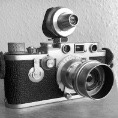
nitroplait Posted yesterday at 03:44 PM Share #1 Posted yesterday at 03:44 PM Advertisement (gone after registration) I was originally under the impression that un-numbered rangefinder coupled lenses would be 5cm Elmar lenses originate from Leica IA cameras and converted to standardised cameras with or without RF coupling. Like the one on my IA converted to IID: Welcome, dear visitor! As registered member you'd see an image here… Simply register for free here – We are always happy to welcome new members! That seem not to be the case. (all data below from our Leica Wiki) The first standardised Leica camera was introduced in 1930 (Leica IC) - but it did not have rangefinder coupling. The first Leica with rangefinder coupling was the IID, which was introduced in 1932. Yet, I notice there are coupled lenses from long before 1932. For example; the fat Elmar 90/4 was coupled already from 1930 it seems. And fuelling this question: I recently I got a nickel Elmar 3.5cm f/3.5 seemingly without SN number, which I would assume indicating it is one of the earliest 3.5cm lenses manufactured, before the Wiki start of the serial number range beginning at 935 (1930), yet mine is RF coupled (heavy cam). The lens in question on the right hand. If my assumptions above are correct, then why would a RF coupled lens exist 2 years before RF cameras existed and why would it not have a serial number? Any ideas? 1 Link to post Share on other sites Simply register for free here – We are always happy to welcome new members! That seem not to be the case. (all data below from our Leica Wiki) The first standardised Leica camera was introduced in 1930 (Leica IC) - but it did not have rangefinder coupling. The first Leica with rangefinder coupling was the IID, which was introduced in 1932. Yet, I notice there are coupled lenses from long before 1932. For example; the fat Elmar 90/4 was coupled already from 1930 it seems. And fuelling this question: I recently I got a nickel Elmar 3.5cm f/3.5 seemingly without SN number, which I would assume indicating it is one of the earliest 3.5cm lenses manufactured, before the Wiki start of the serial number range beginning at 935 (1930), yet mine is RF coupled (heavy cam). The lens in question on the right hand. If my assumptions above are correct, then why would a RF coupled lens exist 2 years before RF cameras existed and why would it not have a serial number? Any ideas? ' data-webShareUrl='https://www.l-camera-forum.com/topic/426184-rangefinder-coupled-lenses-without-sn-numbes/?do=findComment&comment=5910534'>More sharing options...
Advertisement Posted yesterday at 03:44 PM Posted yesterday at 03:44 PM Hi nitroplait, Take a look here Rangefinder coupled lenses without SN numbes . I'm sure you'll find what you were looking for!
jerzy Posted 23 hours ago Share #2 Posted 23 hours ago good questions... some of early II that I have seen had 11 oclock Elmar 5cm (without infinity lock) with no serial number visible oustside, few of them had serial number inside. (but there is no 100% proof that these lenses belonged to camera initially). First II left the factory in November 1931 (see some positing from Giuliobogazzi), possibly pre-production. First step with rangefinder coupled lenses was to define parametrs for rangfinder (relation between deflection of arm and distance - and this is different than in Fodis). But this must have been definded earlier than November 1931. So in theory it is possible that copupled lenses could have been produced as early as first half of 1931. However I would assume that these would have been standard, 5cm Elmars. But who knows. Your lens could be such, or it could have been converted from non coupled end of 31/ beg 32. 1 1 Link to post Share on other sites More sharing options...
willeica Posted 18 hours ago Share #3 Posted 18 hours ago 5 hours ago, jerzy said: it could have been converted from non coupled end of 31/ beg 32. I suspect this was the case most of the time. I have a number of lenses without SNs which are coupled. They also were converted to 7 O'Clock in some cases. As we noted before, Jerzy, some of them have quite short lens barrels. Also, any lens taken from a I Model A is in a 33mm mount and would have to be converted to a 39mm mount to fit on any camera from the I Model C onwards. Leitz had the facilities and skills available to do all kinds of modifications to its lenses. William 1 Link to post Share on other sites More sharing options...
nitroplait Posted 5 hours ago Author Share #4 Posted 5 hours ago 11 hours ago, willeica said: I suspect this was the case most of the time. I have a number of lenses without SNs which are coupled. They also were converted to 7 O'Clock in some cases. As we noted before, Jerzy, some of them have quite short lens barrels. Also, any lens taken from a I Model A is in a 33mm mount and would have to be converted to a 39mm mount to fit on any camera from the I Model C onwards. 17 hours ago, jerzy said: So in theory it is possible that copupled lenses could have been produced as early as first half of 1931. However I would assume that these would have been standard, 5cm Elmars. But who knows. Your lens could be such, or it could have been converted from non coupled end of 31/ beg 32. Thanks to both of you. My little black paint Leica I(A), II(D) and III(F) collection and associated nickel lenses appear to have gone through some early modifications and I am trying to establish a chronology. Please let me know if I get this right: Our Leica-Wiki states that there were 25.000+ non-standardised Leica I (C) produced in 1930. The Leica Wiki also indicate that all interchangeable lenses with serial numbers are produced from 1930 and forward (which makes sense). Were all contemporary lenses that Leica sold for the non-standardised Leica IC manufactured without serial number on the lens? Would that allow me to conclude that un-numbered interchangeable lenses as a consequence must have be produced in early 1930 or before (aside from all the 5cm converted lenses that originate from Leica I(A)) and these lenses would have been intended for the non-standardised Leica I (C)? Do we know how far back Leica would have produced un-numbered interchangeable lenses? Late 1929...? And as my 3.5cm above is 11 O'clock it must have been modified latest in 1933 (before Leica III)- or as Jerzy suggests even earlier - because of what, the "heavy cam"? Best, Niels Link to post Share on other sites More sharing options...
willeica Posted 4 hours ago Share #5 Posted 4 hours ago 31 minutes ago, nitroplait said: Our Leica-Wiki states that there were 25.000+ non-standardised Leica I (C) produced in 1930. Incorrect by a large margin. The number of Non Standardised I Model Cs was slightly less than 3,000. I own the fifth one ever made. To your questions 1. Yes, in my experience. The number on the lens mount was either the full five digits or the last three digits of the camera SN. This practice started with the British conversions by Sinclair and others. 2. The main difference with the I Model C was the introduction of the 39mm mount instead of the 33mm mount on the I Model A. I am always amazed at the number of Leica enthusiasts and writers who do not know this. The practice of numbering lenses per se had not commenced when the I Model C Non Standardised was introduced. The practice was that the lenses and cameras were matched using the little 'bung hole' at the back and a ground glass screen. Only after that was done, the matching numbers were added on lens mount. The lenses were part of general production and the mount and the techniques used would have been appropriate to the camera on which the lens was being mounted. There was some overlap between the production of the I Model A and the I Model C. 3. From when the I Model C Non Std was introduced, my fifth one was delivered on 16.04.1930 4. This was probably because they were anticipating the slow speed dial. The 'heavy cam' sometimes called a 'snail cam' was also anticipating a rangefinder cam on the camera. Barnack often worked on concepts and tested them exhaustively for a long time before those concepts went into production models. Jerzy might like to comment on these aspects. William 1 Link to post Share on other sites More sharing options...
nitroplait Posted 4 hours ago Author Share #6 Posted 4 hours ago 6 minutes ago, willeica said: Incorrect by a large margin. The number of Non Standardised I Model Cs was slightly less than 3,000. I own the fifth one ever made. Oh, I see. I misread the Wiki. Thanks for the clarification. Apparently a range of SN, not a batch: Welcome, dear visitor! As registered member you'd see an image here… Simply register for free here – We are always happy to welcome new members! Link to post Share on other sites Simply register for free here – We are always happy to welcome new members! ' data-webShareUrl='https://www.l-camera-forum.com/topic/426184-rangefinder-coupled-lenses-without-sn-numbes/?do=findComment&comment=5910935'>More sharing options...

Recommended Posts
Create an account or sign in to comment
You need to be a member in order to leave a comment
Create an account
Sign up for a new account in our community. It's easy!
Register a new accountSign in
Already have an account? Sign in here.
Sign In Now